


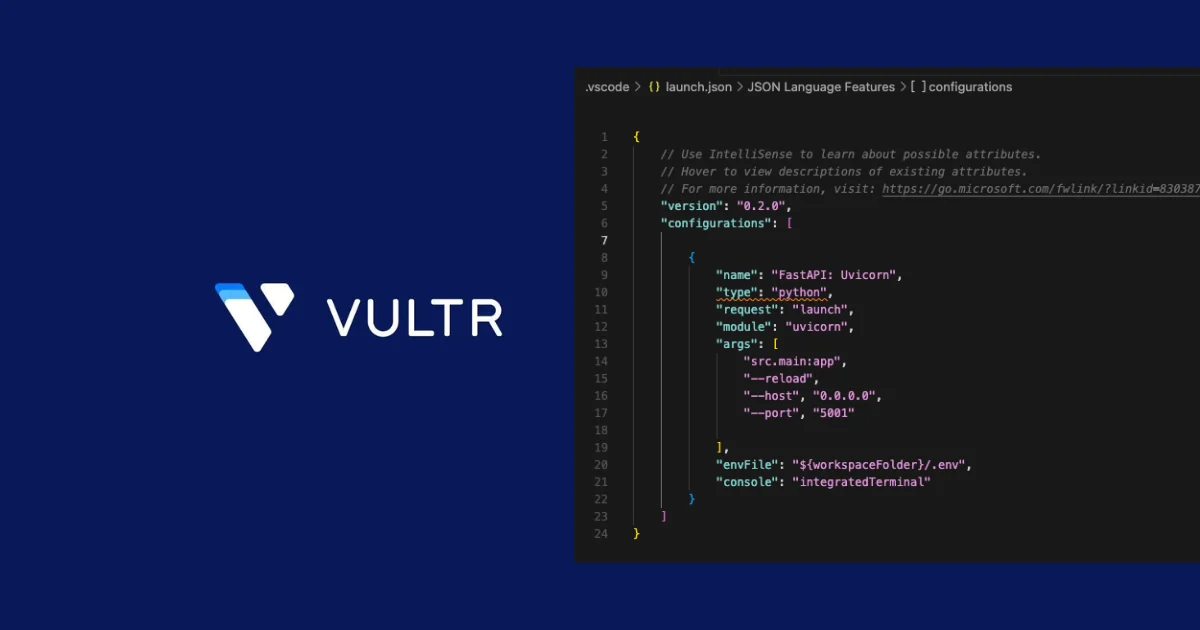
When you are ready to deploy a FastAPI microservice or a Django backend, hyperscalers like AWS often feel like overkill. You don’t want to spend three hours wrestling with IAM roles, VPC configurations, and security groups just to get a server to respond to a simple HTTP request. You want a high-performance Linux box with root access, fast storage, and a predictable monthly bill.
For Python developers prioritizing raw compute power without the enterprise complexity, Vultr Cloud Compute has become the definitive choice in 2026. Here is the objective breakdown.
The “Why” Over The “What”
Python APIs—especially asynchronous ones built on FastAPI or model-serving endpoints—thrive on single-core performance and fast disk I/O. Vultr wins in this space because of its architecture options. Unlike legacy shared hosting or standard virtual private servers (VPS), Vultr’s High Performance and High Frequency compute tiers are backed by the latest generations of AMD and Intel CPUs paired strictly with NVMe SSDs.
This matters because database read/write speeds and data serialization in Python are heavily I/O bound. If your API connects to a local PostgreSQL instance or relies on rapid caching, Vultr’s NVMe infrastructure significantly reduces query latency compared to standard block storage. The control panel is minimalist and developer-centric, allowing you to spin up an optimized Ubuntu environment, SSH in, configure Gunicorn or Uvicorn, and go live in minutes.
Performance and Pricing Reality Check
Vultr markets heavily around its $2.50/month entry-level compute plan. While that looks great on a landing page, here is the major drawback you need to know: that baseline tier is IPv6-only. For most production Python APIs requiring direct IPv4 access to interface with legacy systems, your real starting point is $3.50/month.
If you are running database-heavy workloads or latency-sensitive APIs, you should skip the regular tier entirely and go straight to their High Frequency compute, which starts at $6.00/month for 1 vCPU, 1 GB RAM, and 32 GB of NVMe storage.
Another critical cost trap that catches developers off guard: stopped instances continue to bill. Because Vultr reserves the CPU, RAM, and IP address for your machine even when powered down, you will be charged until you completely destroy the instance. Furthermore, if you want automated weekly backups, you must add a strict 20% premium to your baseline instance cost.
Better Alternatives: Vultr vs. DigitalOcean vs. AWS EC2
Before you commit your API to Vultr, it is essential to see how it contrasts with the immediate competition for developer workloads.
Feature / Provider | Vultr (High Frequency) | DigitalOcean (Premium) | AWS EC2 (t3.micro) |
Real Entry Price | $6.00/mo | $6.00/mo | ~$10.00/mo |
Key Strength | Raw compute & disk I/O | Best-in-class UI & Docs | Infinite ecosystem scale |
Major Drawback | Strict billing on stopped VMs | Hard bandwidth limits | Massive learning curve |
Best For | Python APIs & Data tools | Node.js & general SaaS | Enterprise architecture |
Who This Is Actually For
It’s a perfect fit if:
You are deploying asynchronous Python APIs (FastAPI, Flask) or hosting machine learning inference models.
You need high-frequency CPUs and fast NVMe storage to minimize database latency.
You want transparent, utility-based pricing with generous global bandwidth allocations (and a flat $0.01/GB overage rate).
You should skip it if:
You want a fully managed Platform-as-a-Service (PaaS) like Heroku or Render where you just push code and ignore the infrastructure. Vultr expects you to manage your own Linux environment.
You need extensive, hand-holding customer support. Vultr gives you the bare hardware and gets out of your way.
The Final Verdict
If you want the absolute best price-to-performance ratio for hosting backend services, Vultr is the definitive winner in 2026. While DigitalOcean arguably has a slightly more polished UI, Vultr’s High Frequency compute instances deliver the raw CPU power and NVMe speeds that Python APIs require to handle heavy concurrent traffic without buckling.
Check current Vultr Cloud Compute pricing and deploy your first instance
Affiliate Disclosure: This post contains affiliate links. If you purchase a premium subscription through these links, infodizest earns a commission at no additional cost to you. We only review and recommend tools that have been thoroughly tested in our live development environments.











Responses (0 )