


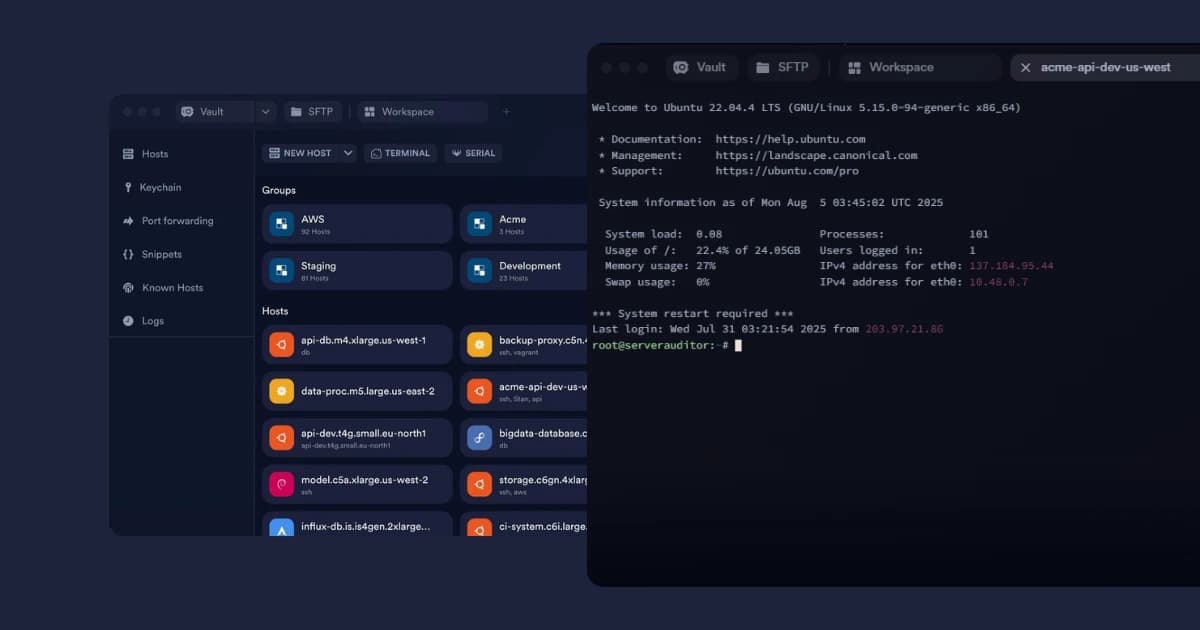
If you manage more than a handful of Linux servers, you already know the pain of SSH key management. You generate a key on your laptop, but then you need to SSH into a production database from your desktop, or worse, troubleshoot an outage from your phone while on a train.
For years, developers have hacked together solutions—storing keys in secure notes, manually moving config files, or relying on barebones utilities. Termius exists to eliminate this friction entirely. It is a premium, cross-platform SSH client that treats your infrastructure like a modern, synchronized workspace.
But with a price tag of $10 per month for its core features, is it actually worth paying a subscription for a terminal? Here is the candid breakdown of why Termius has become the standard for modern sysadmins, and where it objectively falls short.
The “Why” vs. The “What”
It is easy to list what Termius does: it handles SSH, SFTP, Mosh, and port forwarding, and it runs natively on macOS, Windows, Linux, iOS, and Android. But the raw feature list doesn’t explain why it justifies its price tag.
Termius matters because of how much configuration and debugging time it saves. The “Pro” tier gives you an encrypted cloud vault that syncs your hosts, groups, and SSH keys across every device you own. You set up a server connection once, and it is instantly available on your iPad or Windows machine.
Furthermore, the Snippets feature drastically cleans up repetitive backend workflows. Instead of searching through your Bash history or a Notion document for that one specific Docker compose command, you save it as a snippet in Termius and execute it across multiple servers simultaneously. It is designed with a minimalist aesthetic that keeps visual clutter low while keeping powerful tools immediately accessible.
Explore Termius’s time-saving features here
The Drawbacks: Let’s Be Candid
If you are considering Termius, you need to be aware of its limitations before replacing your current terminal setup:
The Core Value is Paywalled: Termius has a free “Starter” tier, but it does not include cross-device sync. If you want the cloud vault—the main reason to use Termius—you have to pay $120 a year (billed annually at $10/month). For many solo developers, paying a recurring subscription for an SSH client feels fundamentally wrong.
Heavy for a Terminal: While the UI is incredibly polished, it is a heavier application than standard lightweight command-line interfaces. It will consume more memory than a barebones macOS Terminal or standard Ubuntu bash environment.
Overkill for Hobbyists: If you only have a single VPS or a single local test environment, Termius is an unnecessary luxury. Its value scales linearly with the complexity and size of your infrastructure.
The “Better Alternatives” Comparison
How does Termius stack up against the competition in 2026?
SSH Client | Pricing | Key Feature Advantage | Best For |
Termius | Free basic / $10/mo Pro | Encrypted cross-device sync & mobile app | Sysadmins and developers managing dozens of servers across multiple devices. |
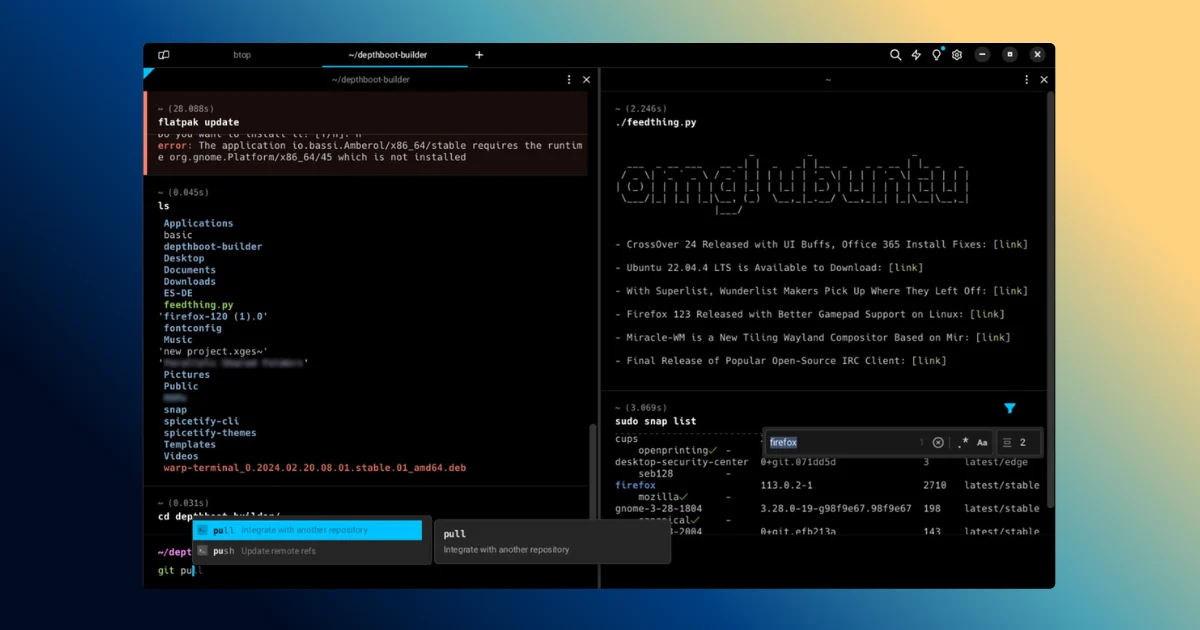
Warp | Free / $12/mo Pro | AI-driven native terminal (Rust-based) | Developers who want a lightning-fast, collaborative local terminal experience. |
MobaXterm | Free / $69 one-time | Built-in X11 server and vast toolset | Windows-exclusive users who need deep, legacy system administration tools. |
Termius vs. Warp
Warp is a massive disruptor in the terminal space. Because it is written natively in Rust, it is significantly faster and excels as a local terminal replacement, offering block-based input and deep AI integration. However, Warp lacks the seamless mobile companion apps and the dedicated encrypted remote-host vault that makes Termius so powerful for remote server management.
Termius vs. MobaXterm
If you are strictly on Windows and refuse to pay a subscription, MobaXterm is the heavyweight champion. It gives you a built-in X11 server, RDP, VNC, and SSH in one package for a single flat fee (or for free, with limitations). But MobaXterm can feel like a legacy tool—the UI is heavily cluttered and intimidating. Termius offers a clean, precise aesthetic that gets out of your way, which is often worth the premium for developers who value a distraction-free workspace.
Compare MobaXterm’s feature set here
The Final Verdict
Termius is the cleanest, most efficient way to manage a complex remote infrastructure across multiple devices. If you find yourself frequently switching between a desktop, a laptop, and a smartphone to fix backend issues, the Pro tier’s synchronization will easily pay for itself in saved time and frustration.
However, if you only manage a few servers from a single machine, or if you strictly oppose subscription models for utility software, you are better off sticking with Warp or your OS’s native terminal environment.
Check current Termius pricing and start a free trial here
Affiliate Disclosure: This post contains affiliate links. If you purchase a premium subscription through these links, infodizest earns a commission at no additional cost to you. We only review and recommend tools that have been thoroughly tested in our live development environments.









Responses (0 )